Why the Philippines Is Positioned for Office Supplies Export
The Philippines has spent decades building the trading relationships, logistics infrastructure, and labor base that support export-oriented businesses, and paper products and office supplies are a natural category within that broader export economy. Philippine wholesalers already handle a wide range of internationally recognized brands, from Double A and PaperOne to Xerox Vitality and Chamex, which gives DTI-registered exporters an existing catalog to offer international buyers rather than needing to build brand relationships from scratch.
Geography also plays a role. The Philippines sits within reasonable shipping distance of several Pacific and Asian markets, Papua New Guinea, Australia, Indonesia, and Singapore among them, while still maintaining container shipping lanes to more distant markets including Canada, South Africa, South Korea, and the UAE. For importers in these regions, a Philippine-based exporter can offer a genuinely diversified paper and office supplies catalog without the buyer needing to source separately from multiple countries.
Product Categories Suited to Export
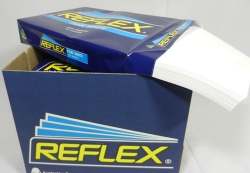
Bond paper is the most straightforward export category, given its stable shelf life, predictable packaging requirements, and broad international demand across offices, schools, and government institutions. Thermal paper rolls, used in POS systems, ATMs, and cash registers, represent a growing export category as retail and banking infrastructure expands across emerging markets. School supplies and general office stationery, pens, notebooks, folders, and writing materials, round out a typical export catalog, often bundled with paper orders to fill container space more efficiently.
- Bond paper across multiple brands and GSM grades
- Thermal paper rolls for POS, ATM, and cash register use
- General office supplies: folders, envelopes, pens, staplers, notebooks, whiteboards
- School and educational supplies: writing materials, exercise books, art supplies
The Export Process, Step by Step
A typical export order begins with the importer and exporter agreeing on product specification, quantity, and Incoterms, the standardized international trade terms that define who is responsible for freight, insurance, and customs clearance at each stage of the shipment. Common terms for bulk paper and office supply exports include FOB, free on board, where the exporter's responsibility ends once goods are loaded onto the vessel at the port of origin, and CIF, cost, insurance, and freight, where the exporter arranges and pays for shipping and insurance to the destination port.
Once terms are agreed, the exporter prepares the shipment, packs and containerizes the goods, and assembles the required documentation: a commercial invoice, packing list, certificate of origin, and bill of lading at minimum, with additional documents such as fumigation certificates for wood pallets required depending on the destination country's import regulations. The container is then booked with a freight forwarder or shipping line, and transit time to the destination port depends on the specific route, ranging from roughly a week or two for nearby Pacific and Southeast Asian ports to several weeks for more distant markets.
Customs and Import Regulations at the Destination
Import regulations differ by destination country, and it is generally the importer's responsibility to understand and comply with their own country's customs duties, tariffs, and any product-specific import requirements, though an experienced exporter can help by providing accurate, complete documentation that avoids unnecessary customs delays. Buyers in markets with stricter import controls, such as Australia, should confirm with their own customs broker what documentation their country requires in addition to what the exporter provides as standard.
Packaging for Long-Haul Ocean Freight
Paper and office supplies generally travel well by ocean freight, but packaging quality determines whether goods arrive in sellable condition after a multi-week transit through varying humidity and temperature conditions inside a shipping container. Reams of paper need moisture-resistant wrapping, cartons need to be sturdy enough to stack several layers deep without crushing the goods underneath, and the overall container load needs to be arranged to prevent shifting during rough seas.
Exporters with real experience shipping to humid or tropical destinations, or across routes with multiple transshipment points, generally have packaging practices refined over many shipments, which is one of the more overlooked but important factors an importer should evaluate before committing to a new supplier relationship, since packaging failures typically are not covered by standard cargo insurance if they are classified as inherent product defect rather than transit damage.
Container Loading: FCL vs LCL
Most bulk paper and office supply exports move as full container load, FCL, shipments, since container-level pricing is more efficient per unit than smaller shipments. A standard 20-foot or 40-foot container can carry a substantial volume of bond paper, thermal rolls, or office supplies, and exporters typically price FCL shipments more competitively than less-than-container-load, LCL, orders.
For importers testing a new supplier relationship or ordering a smaller initial volume, LCL shipping or consolidated orders combining multiple product categories, bond paper alongside thermal rolls or general office supplies, for instance, can be a practical way to reach a reasonable shipment size without committing to a full container on the first order. Discussing this option directly with the exporter before finalizing an order is worthwhile for any importer new to a given product category or supplier.
Freight Forwarders and Choosing the Right Shipping Route
Most export shipments of bond paper and office supplies from the Philippines move through a freight forwarder, an intermediary that books cargo space with shipping lines, coordinates port handling, and manages the documentation flow between exporter, carrier, and destination customs. A well-connected freight forwarder can meaningfully affect both cost and reliability, since forwarders with strong relationships on a given trade lane often secure better rates and more consistent vessel space than an exporter booking shipments ad hoc.
Import route also affects total transit time in ways that are not always obvious from a map. A direct sailing to a nearby Pacific port, such as those serving Papua New Guinea or Australia, is often faster and more predictable than a route requiring transshipment through an intermediate hub, while shipments to more distant markets like Canada, South Africa, or the UAE typically involve at least one transshipment regardless of which forwarder is used. Importers should ask their supplier or forwarder directly whether a quoted transit time assumes a direct sailing or a route with transshipment, since the difference can be substantial.
Payment Terms in International Trade
Payment structure is one of the first things a first-time importer and a Philippine exporter need to align on, and it varies with how much trust and history exists between the two parties. New relationships commonly start with terms weighted toward the exporter's security, such as a deposit paid before production or picking begins and the balance paid before or upon shipment, sometimes formalized through a letter of credit for larger orders. As a relationship matures across multiple successful shipments, terms often become more flexible for both sides.
Importers should treat a supplier's willingness to discuss payment terms openly, and to explain clearly what triggers each payment milestone, as a positive sign, and should be cautious of arrangements that ask for full payment far in advance with limited documentation or verification of the exporter's legitimacy in return.
Common Pitfalls First-Time Importers Should Avoid
The most common mistake among first-time importers of Philippine office supplies is underestimating total landed cost by focusing only on the per-unit price quoted by the exporter, without fully accounting for freight, insurance, destination port handling fees, and any import duties or taxes that apply in their own country. A price that looks attractive on a supplier's initial quote can end up costing considerably more once the full logistics chain is priced in, which is why experienced importers request a landed cost estimate, not just an FOB or ex-works unit price, before comparing suppliers.
A second common pitfall is skipping a specification confirmation step and assuming that a brand name alone guarantees a specific grade, size, or packaging standard. Because the same brand can be offered in multiple GSM grades and finishes, importers should always confirm the exact specification in writing, ideally supported by a product data sheet or sample, before finalizing an order, rather than relying on the brand name as shorthand for a specific product.
Building a Long-Term Export Relationship
The most successful import relationships tend to move beyond a single transactional order fairly quickly, evolving into a recurring arrangement where the importer places orders on a predictable schedule and the exporter, in turn, can plan sourcing and container bookings around that predictability, often resulting in better pricing and priority handling for the importer over time. This kind of relationship takes a few successful shipments to establish, and it is worth an importer's patience through an initial trial order or two rather than switching suppliers at the first minor hiccup.
Clear, consistent communication in both directions, specification changes flagged early, shipment delays explained promptly, and payment handled on the agreed schedule, does more to build a durable long-term export relationship than price negotiation alone, and it is often the deciding factor in whether an importer keeps returning to the same Philippine supplier year after year.
Working With an Export-Ready Wholesaler
Not every domestic wholesaler is equipped to handle international orders, even if they carry the right products. An export-ready supplier should have DTI registration appropriate to export activity, experience preparing the documentation required for international shipment, and established relationships with freight forwarders capable of handling the destination country and port. Importers should ask directly about a prospective supplier's export track record, which countries they have shipped to previously, and what Incoterms they typically work under, before finalizing a first order.
RC Printshoppe and General Merchandise is a DTI-registered wholesaler and exporter based in Zone V, Sogod, Southern Leyte, supplying bond paper, office supplies, school supplies, and thermal papers to international buyers in markets including Papua New Guinea, Australia, the UAE, Singapore, Canada, South Africa, South Korea, and Indonesia. International buyers interested in sourcing office supplies or bond paper from the Philippines are welcome to reach out and request a quote for their target volume and destination.